Showing posts with label Video Art. Show all posts

Tuesday, March 15, 2011

Takahiko Iimura

Pretty stoked to check this out, and I have been hearing good stuff about this new space. I didn't make it to the opening, which appropriately happened during the "supermoon," but this guy did and blogged about it.

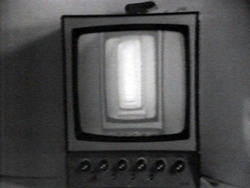
I was introduced to Iimura's work through my research on an exhibition and publication with Electronic Arts Intermix, called Vital Signals:Early Japanese Video Art (2010). The work included in the exhibition was Camera, Monitor, Frame from 1976.

Additionally, there will be a screening of Iimura's Early Experimental and Conceptual videos, and a benefit fundraiser with donations towards Red-Cross relief efforts in Japan.


Microscope Gallery
4 Charles Place, Brooklyn NY 11221 Tel: 347.925.1433
E-mail: info@microscopegallery.com www.microscopegallery.com
Hours: Thurs to Mon. 1-6PM

Mar 19 - Apr 11, 2011
Opening Reception:
Sat Mar 19 6pm - 9pm

Takahiko Iimura
BETWEEN THE FRAMES
installation, digital drawing, video, and other new & evolving works by the film & video pioneer

Verbatim from the gallery's site:

TAKAHIKO IIMURA
Between The Frames
w/ live 16mm projection performance of the ever-changing “Circle and a Square”

Microscope Gallery is honored to present the first Brooklyn solo exhibition of the film and video pioneer Takahiko Iimura. Between The Frames is a comprehensive exhibition featuring works made from 1975 to the present, many of which are constantly evolving. The new suspended installation “400 frames” uses ink drawings from 1975. A new print series “MA: The Stones Have Moved” are made from digital drawings related to his 2004 animated video of a Zen garden in Kyoto of the same title. Also on display: Iimura’s famous 1993 “funny faces” silkscreens and video game installation based on Derridda’s “Differance” dealing with physicality of language “AIUEONN Six Features“, never-before-seen sculptures made from 16mm film loop and more.

Iimura has been working with the moving image on film since the 60s and video since the early 70s. After moving to New York in the late 60s became involved with the avant garde scene along side Yoko Ono and Nam Jun Paik and is recognized as one of the most important Japanese artists today. His work is shown widely with numerous solo shows including MoMA, the Whitney Museum, the National Gallery Jeu de Paume, Paris, Reina Sofia National Museum, Madrid, and the Tokyo Metropolitan Museum of Photography, Tokyo. Iimura currently lives and works in Tokyo and NYC.

“His [Iimura’s] Japanese origins contributed decisively to his uncompromising explorations of cinema’s minimalist and conceptual possibilities. He has explored this direction of cinema in greater depth than anyone else. To review all of Iimura’s work…is an important occasion for all who are concerned with the development and pleasure of cinema as an art.” — Jonas Mekas

Please note: Takahiko Iimura is generously donating his proceeds on the sale of sculptures from the series One Second Loop (= Infinity) to the American Red Cross for relief efforts in Japan. Additionally, Microscope Gallery is donating 15 % of the sales of all works of the exhibition.


from video-installation AIUEONN SIX FEATURES, 2′ 30″ (vers. I), 7′ (vers. II), col, sound, 1993


Notes on the screening program (verbatim from program note):


For many years, Japanese experimental film was Takahiko Iimura.
- Malcolm Le Grice, Time Out, London.

In connection with his current exhibition BETWEEN THE FRAMES, Takahiko Iimura brings a selection of his earliest film and video works to the gallery. The evening will be divided into two parts: “60 Experiments” with four 16 mm films made between 1962 & 1964 including his famous AI (LOVE); and “Early Conceptual Videos”, six short video works that contributed to the birth of conceptual video art. A Q&A will follow the screening.

60s EXPERIMENTS
Original 16mm films

Kuzu (Junks)
1962, 10min., b/w, music by Takehisa Kosugi
It’s a mixture of [dead]animals, pieces of [broken] furniture, industrial waste, kids playing. I didn’t have in mind any of the kind of historical perspective, nor was I trying to make an ecological statement. I was showing the new landscape of our civilization. My point of view was animistic. I tried to revive those dead animals metaphorically and to give the junk new life. – - Takahiko Iimura (from “An Interview with Taka Iimura”, Scott MacDonald, Journal of the University Film Association XXXIII, 4, Fall 1981)

Ai (Love)
1962, 10min., blown up from 8mm, b/w, music by Yoko Ono
“I have seen a number of Japanese avantgarde films at the Brussels international Experimental Film Festival, at Cannes, and at other places. Of all those films, Iimura’s LOVE stands out in its beauty and originality, a film poem, with no usual pseudo-surrealist imagery. Closest comparison would be Brakhage’s LOVING or Jack Smith’s FLAMING CREATURES. LOVE is a poetic and sensuous exploration of the body…fluid, direct, beautiful.” – - Jonas Mekas, Film Culture,1966, New York

On Eye Rape
1962, 10min., b/w, silent, Co-Pro. Natsuyuki Nakanishi
The second film (On Eye Rape) was made with footage I picked out of some trash. It was originally an educational film which recorded a plant growing out of the ground. The content isn’t important. I punched almost all the frames with a puncher. I made big holes so that when it was projected, people could barely see what was originally in the frames. I didn’t punch every frame; there was a lot of flicker from the holes. People got very annoyed and complained. They were afraid they would get hurt by the light. That film was called, in English, On Eye Rape (1962). In fact, I had also inserted (a few frames of) *some porno shots. Pornography was forbidden in Japan; It’s still forbidden…. [...] *ps. This is in fact subliminal shots against censorship.” – - Takahiko Iimura (from “An Interview with Taka Iimura”, Scott MacDonald, Journal of The University Film Association XXXIII, 4, Fall 1981)

A dance party in the kingdom of Lilliput
1964, 12min., b/w, sound
A surper-real comedy with Sho Kazakura. The film is divided into a number of very short scenes or chapters, each with a title at random. We see him lame in a crowd, see him running up stairs, see him absolutely naked, watch him urinate, etc. An anthology of discontinuous happenings and events.” – - T I

“The movie may well be one of the first ‘Conceptual’ film ever made anywhere in the world. It was a rather slow, but clerly defined daily motions of Kazakura, a mysterious underground figure of Japan, who is still unknow in Tokyo, yet has a strange presence in his remote area of Japan, KYUSYU Island.”
- – Nam June Paik, 1987

(Total 42 minutes)

EARLY CONCEPTUAL VIDEOS

After coming back from New York in 1969, I began video production in Tokyo. Working in experimental film since the early 1960s, I first combined the art of film with video, thus making a kind of flicker effect in video in two pieces: “A Chair ” (1970) and “Blinking” (1970). These videos are experiments in perception, and are very minimal formally, consisting mostly of a single object. “Time Tunnel” (1971) is an attempt at time travel in a very conceptual sense. The video combines a repetition of the countdown leader of film, which runs the numbers 10 to 1 , with the feedback effect of video. The result is a tunneling of the numbers in time. ”Man and Woman” (1971) shows the full body of a man and a woman shot from above, in the posture of the drawing of a man by Leonardo Da Vinci, without movement. They are shown alone as well as together one over (or under) the other, narrating in words their positions at the same time. “Visual Logic (and Illogic)” (1977) shows the visual logic (and illogic) of various signs in letters and simple forms on paper combined with limited camera movement and voice-over narration. These early videos constitute the very early experiments of a particular “conceptual video” that almost no other video artists had ever tried at that time. – - Takahiko Iimura

A Chair
1970, 6min., b/w, sound

Blinking
1970, 2min., b/w, sound

Time Tunnel
1971, 5min., b/w, sound

Man and Woman
1971, 2min., b/w

Visual Logic (and Illogic)
1977, 8min., b/w, sound

(Total 23 minutes)


Thursday, January 20, 2011

Martha Rosler at EAI

Last night, Electronic Arts Intermix presented "Martha Rosler: Kitchen Theatre" to a very full house. The selection of Rosler's videos ended with the premiere of most recent project, which documented the re-performance of her 1975 work, 'Semiotics of the Kitchen,' the first work screened in the program. The original work, which features Rosler before a static camera listing off an alphabetized list of cooling utensils, as she "demonstrates" the objects' use with gestures, which depart from the traditional gestures associated with the tool.


The 2011 performance, held at Whitechapel in London, documented an open call, where women convened and re-performed the iconic video within the gallery space. A revolving cast of twenty-six women participated in the live restaging of Rosler's script. The 2011 work traces their auditions, rehearsals, and finally, the public event.

The program also celebrated Rosler's forthcoming publication The Art of Cooking, a rediscovered manuscript created by the artist on the rhetorics of cooking and art production, made up almost entirely of quotations from cooking manuals and books on gastronomy.


The program:

A budding gourmet
1974, 17:45 min, b&w, sound

Semiotics of the Kitchen
1975, 6:09 min, b&w, sound

The East is Red, The West is Bending
1977, 19:57 min, color, sound

Semiotics of the Kitchen: an Audition

2011, 10:26 min, color, sound

Tuesday, January 18, 2011

Susan Hiller Retrospective at the Tate Britain


February 1– May 15, 2011

This major survey exhibition at Tate Britain will focus on a selection of Hiller's key works, including many of the pioneering mixed-media installations and video projections for which she is best known. It will be the largest presentation of her work to date, providing a unique opportunity to follow her exploration of dreams, memories and supernatural phenomena across a career of almost four decades.

Emerging as an artist in the early 1970s, Hiller’s output has taken many different forms. Her works however often derive from a similar process of collecting, cataloguing and restaging cultural artefacts and experiences. This exhibition will bring together key examples of this practice, with which the artist highlights the subjectivity of perception and imagination. Enquiries/Inquiries 1973-5, for example, exposes the inconsistencies found in comparing an American and a British encyclopaedia, while Magic Lantern 1987 uses converging projections of coloured light to create after-images in the mind’s eye. On other occasions, Hiller’s work excavates hidden layers of cultural history, whether as recordings of extinct languages or as collections of British seaside postcards. In the mixed-media installation Monument 1980-1, the viewer is invited to sit on a park bench and listen to a tape of the artist’s voice, while looking at photographs of a neglected Victorian memorial. In bringing together these diverse works, the exhibition will allow visitors to survey the many ways Hiller’s unique approach has been used to explore meaning, memory and perception.

The exhibition will also focus on Hiller’s interest in the subconscious or unconscious mind. From early in her career, she explored these themes by collecting the memories of dreams and by using ‘automatic writing’, performed as a continuous stream of consciousness. This investigation into the undercurrent of human thought or vision was later expressed in installations such as Belshazzar’s Feast / The Writing on the Wall 1983-4. Sitting at the heart of the exhibition, it takes the form of a living room environment, in which a glowing TV screen shows images of a burning fire, accompanied by a mysterious, hypnotic soundtrack. More recent work continues this interest in visionary and supernatural experiences, such as Psi Girls 1999, a five-screen projection featuring clips from Hollywood movies about young women with telekinetic powers, and the compelling audio-sculpture Witness 2000, in which a cloud of hanging audio speakers offers the visitor hundreds of accounts of extraterrestrial encounters.

Susan Hiller was born in Florida, USA in 1940. She studied in Massachusetts and New Orleans, receiving a PhD in anthropology before becoming disillusioned with academia. She moved to London in 1969 and began her career as an artist, first exhibiting her work in 1973. She continues to live and work in Britain and has been the subject of many exhibitions, including at the ICA, London in 1986; Tate Liverpool in 1996; and BALTIC, Gateshead in 2004.

The exhibition is curated by Ann Gallagher, Head of Collections (British Art), Tate, with Sofia Karamani, Assistant Curator, Tate Britain. The exhibition will be accompanied by a richly illustrated catalogue published by Tate Publishing.

Monday, January 10, 2011

Rewind the BETAMAX of life: Nam June Paik at Tate Liverpool and FACT by Peter Merrington

I was gearing up to blog about this exhibition, when I ran across this piece by Peter Merrington:

By Peter Merrington on Wednesday, January 5th, 2011 at 10:00 am.

lasercone.jpg
Nam June Paik in collaboration with Norman Ballard, 
Laser Cone, 2001/2010

Installation view at FACT (Foundation for Art Creative Technology) Photographer: Stephen King

Nam June Paik (1932 – 2006) is an artist fabled for what he has achieved, as the instigator of video art, the pioneer of media art and through his influence on the indebted MTV generation. It's as if his career is almost made for the retrospective exhibition. His work is bound to his legacy, and his influence is hard to encompass. The importance of this legacy asks two parallel questions, how to preserve, present and document but also how to react, trace and respond. Both are targeted through a new joint exhibition of Paik's work at Tate Liverpool and FACT (Foundation for Art and Creative Technology), the first major retrospective of his work since his death in 2006 and the first exhibition of his work in the UK since 1988.

Tate presents a comprehensive chronicle of Paik's movements through the avant-garde, in performance, composition, television and sculpture. There are TV sets, robots and Buddhas, mixed with historical documentation, vitrines filled with exhibition programs, posters and photographs and timelines drawn on walls, which denote his many collaborators and read like a roll call of the most influential artists of the 20th century - John Cage, Karlheinz Stockhausen, Joseph Beuys and Merce Cunningham.

In contrast to the Tate, where you can look and listen with historical meticulousness, at FACT you are given a remote control. Here you are encouraged to relax, in an archive lounge, and browse a collection of his video works at leisure. Or lie back underneath Laser Cone (1998) and be dazzled.

The show’s split nature, across two venues, pays tribute to the very legacy that it seeks to explore. In some ways, FACT, as an organization that has grown over the last 20 years through commissioning and presenting new media and video, is indebted to Paik’s original exploration of new technologies.

Nam June Paik’s story is played out right through the exhibition. Born in Seoul, Korea in 1932, he studied art, philosophy and composition in Japan and Germany. Later, he was greatly influenced by encounters with John Cage and George Maciunas, from whom he took up the fluxus agenda. He made one of his earliest video works in the shop where he bought the first portable video recorder, the Sony Portapak. He shot a simple fluxus action, buttoning and unbuttoning his shirt. He also paid homage to Cage’s 4’33, in Zen for Film, a silent, 8-minute, blank film.

Nam June Paik, Zen for Film, 1964/1965

Through his meditations on the potential elegance and grace of the video medium, Paik embraces and plays with nature, from simply placing a magnet on top of a television to representing various natural forms on screen.

Egg Grows, No. 4 (1984) is a sculpture made of a live video of an egg, replicated on 8 individual monitors, each placed next to a monitor of greater size. The on-screen eggs get scaled up and angled over at each repetition. This simple and coherent setup is mirrored in the mesmeric, One Candle (1989). The fleeting image of a candle flame is produced by three projectors, all running off the same video camera pointed at a burning candle. The red, green and blue light of the projectors shows ephemeral flickers of candle flame as it slowly burns itself out. The spiritual quality of the work reflects Paik’s interests in Zen Buddhism, evident in much of his work. His drive towards beauty is enhanced by the dichotomy of the real flame and the projected image. The three very large, now obsolete projectors look like giant boulders propped on the floor and create an amusing contrast of scales with the small and delicate candle flame.

PAIK-Egg-Grows,-Med1.jpg
Nam June Paik, Egg Grows, No. 4, 1984
Photo: Helge Mundt

one_candle11.jpg
Nam June Paik, One Candle, 1979 - 1992

Paik is most successful in expressing the beauty of the video medium in his Moon is the Oldest TV 1965 (1992 version). Paik created a transcendental space, an installation in a backed out room, only lit by light emitted from eleven televisions, arranged on plinths, in an arc. The group of screens flow across the back of the room, each filled with an image of the round moon. As an object of continuous human obsession and gaze, the moon serves well to illustrate Paik’s mastery in harnessing the potential of the video image and taking the television screen into undeveloped territory. The televisions themselves fade into the darkness of the space and all that remains is the haunting light that they emit.

Like his close collaborator, Joseph Beuys, Paik deeply believed in the power of art to positively influence society. He possessed a potent vision of the potential of video as essential democratic media with the ability to unite and connect people. On New Year’s Day 1984, Paik presented the first international satellite installation to over 25 million viewers, linking New York, Paris, Germany and South Korea. Good Morning Mr Orwell (1984) was something of an avant-garde art variety show featuring Philip Glass, Laurie Anderson, Peter Gabriel, Merce Cunningham, and Charlotte Moorman with her and Paik’s TV Cello. For Paik, it was a response to Orwell’s dystopian vision of the use of totalitarian television control in 1984. His spirit and enthusiasm for connecting communities follows through his trademark vivid, cut and paste, slash edits and video synthesis.


Nam June Paik, Good Morning Mr. Orwell, 1984

For all the glowing, vibrant light and color often on show, it is a quiet, muted object that sits in the center of the gallery at Tate that gets to the heart of Paik’s legacy and purpose. Rembrandt Automatic (Rembrandt TV) (1963/1976) is a television set resting on its screen. The television, face down, becomes an alien object; its function stripped, unnatural and ambiguous. The muted form is left with no content but the brand name visible on the back, titled, Rembrandt Automatic. It resonates further in the historical context of the works shown at Tate, where the age of the equipment originally employed by Paik adds a retro appeal. The rates at which the objects take on obsolesce and a museum piece quality is very evident. This collision of art and technology, a chance object, exemplifies what Paik achieved so brilliantly, he was a champion and conqueror of the everyday, right from his fluxus roots to his laser extravaganzas, he foresaw a future of technology that was ubiquitous and fantastic, as he wrote, “without electricity, there can be no art.”

Peter Merrington is an artist and writer currently based in Liverpool.